
The technology gap between a reseller and a factory floor — and the bridge we built across it
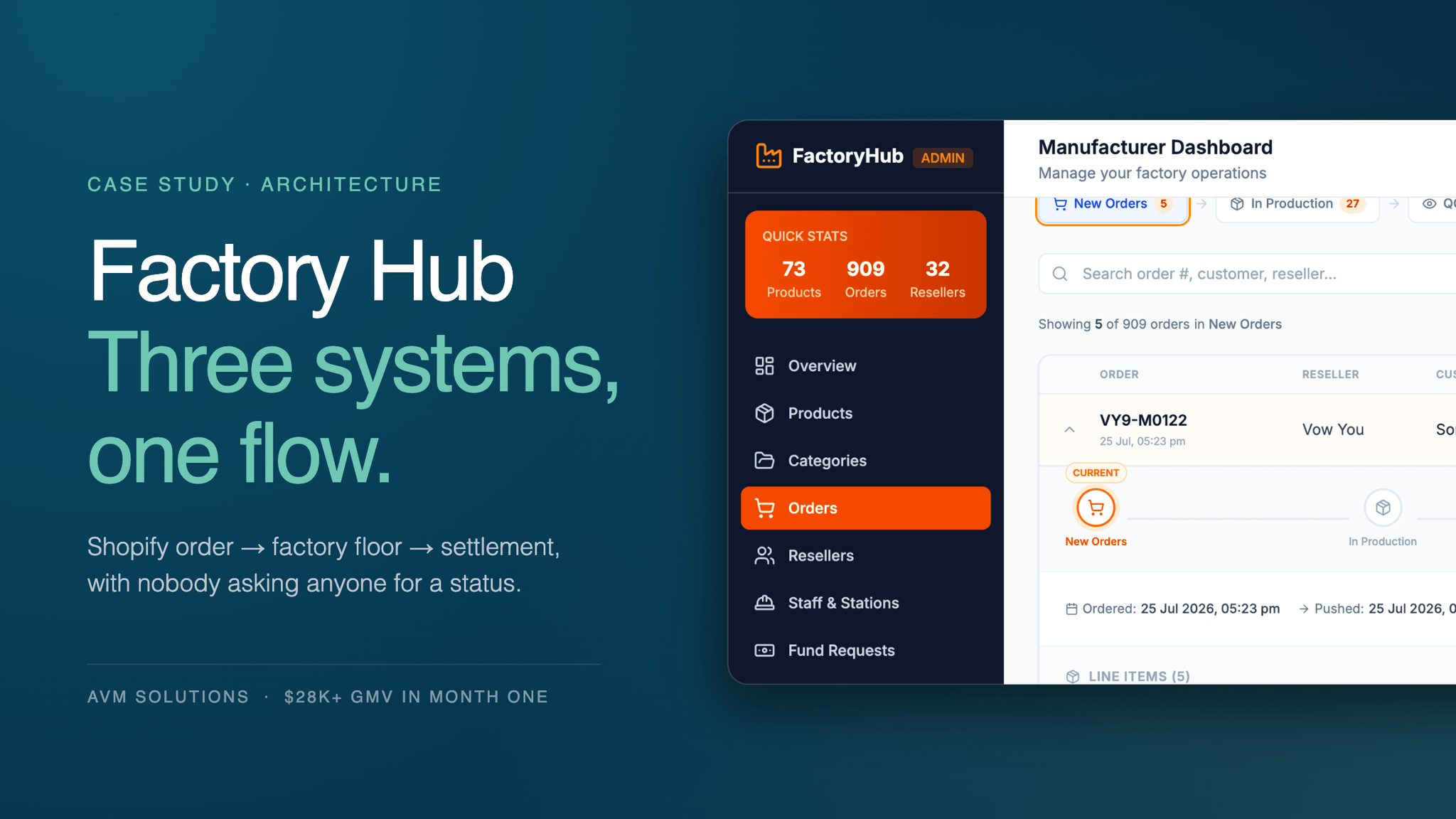
A real, deployed platform connecting e-commerce resellers, their online stores, and the manufacturers who fulfil their orders. Three systems, one flow — running live, processing real orders, and settling money on delivery. Built end to end by AVM Solutions (Ad Victoriam Marketing).
- systems
- 3 — portal · bridge · factory os
- stack
- next.js · express · supabase
- hosting
- vercel · railway
- integrations
- shopify (oauth + webhooks) · shiprocket
- status
- live in production
- month one
- 839+ orders · $28K+ gmv
The opportunity
Resellers and dropshippers have a broken middle. They get orders on their online store — but the moment an order lands, the chaos begins. Order details, customer information, shipping addresses and personalisation notes all get passed to their fulfilment centres manually, over phone calls and messy, constantly-updated spreadsheets. There is no reliable way to track production status, QC, packing, dispatch or payments. Everyone is flying blind, and everything is done by hand.
Our founder ran e-commerce and dropshipping businesses for more than five years before AVM, so this was a lived problem rather than a researched one. The failure point is specific: there is a technology gap sitting between the end customer, the reseller and the fulfilment centre — the store, the shipping system and the payment system all need to talk to each other, and none of them does it automatically.
Nobody had built this for resellers because of cost and complexity. Resellers are capital-light by definition: they resell other people’s products precisely because they don’t have funds to invest. Asking them to build or buy a complex integrated system was never realistic. So the gap stayed open.
Three systems, one flow
1 · Reseller Portal — Next.js, deployed on Vercel. The reseller’s control panel. They connect their Shopify store for real-time order sync, connect their shipping partner, push orders to fulfilment centres, and track orders, revenue, losses and wallet funds in one place.
2 · Shopify App — Express, deployed on Railway. The bridge. It connects a reseller’s Shopify store to the Portal, custom personalisation fields included, so orders flow in automatically with all the detail the manufacturer needs.
3 · Factory OS — the manufacturer’s control tower. Fulfilment centres manage incoming orders from multiple resellers, update production status, and handle shipping details for each dropshipped order.
How it works
A single order’s journey through all three systems:
- Connect & import. The reseller logs into the Portal, connects their Shopify store, and imports dropship products — with the manufacturer’s personalisation field sets — into their store.
- Order lands. A customer orders on the reseller’s Shopify store. Shopify fires a webhook to the Shopify App carrying the order details, personalisation line items, customer info and shipping address.
- Sync. That data syncs into the Reseller Portal automatically. Shipping and payment integrations run over API — Shiprocket for shipping, the wallet for payments.
- Push to production. The reseller pushes the order to the manufacturer. At that moment the reseller’s wallet is debited, and the order plus customer shipping details are handed to the manufacturer to make, pack and ship on the reseller’s behalf.
- Factory floor. Four tracked stages: accept order → under production → QC & packed → dispatched. Floor workers update each stage in real time from a dedicated in-hand mobile app.
- Status returns. That live status syncs straight back to the reseller’s Portal, so the reseller always sees the true state of every order.
- Settlement. On successful delivery, funds settle from the reseller’s debited wallet into the manufacturer’s account.
The choices we made, and why
- Next.js on Vercel for the Portal — a modern framework with free, one-click deployment straight from Git. Fast to ship, easy to iterate.
- Express on Railway for the Shopify App, kept separate from the Portal, because Shopify is a third-party system that needs a live server to talk to for app events. Railway was the cheap, reliable way to run that server independently.
- OAuth in the Shopify App — how Shopify lets the app act on a store’s behalf without the store ever sharing its password.
- Webhooks for order events, APIs for shipping and payments. Webhooks push order data the instant an order is placed; APIs let us talk to Shiprocket and the wallet on demand.
- Supabase as the database — free to start, easy to manage, and it scales when needed.
- Fallback sync. If a webhook fails to arrive, the system re-syncs after a set interval, plus there is a manual sync option and validation checks. Order data doesn’t silently vanish.
The question was never whether an integration would fail. It was whether anyone would find out from a customer.
What it did in month one
- 28+ resellers onboarded
- 839+ orders processed through the platform
- $28K+ total GMV flowing through the system
- $15K+ in reseller-to-manufacturer business — the B2B fulfilment layer this platform specifically unlocked
All of it in the first month after launch. What it replaced: per-order manual updates, hand-managed shipping and customer details, and unorganised spreadsheet juggling. That work now happens automatically in the background, so resellers spend their time selling instead of managing orders, updates and shipping.
Infrastructure was kept deliberately lean for the MVP — free and low-cost tiers on Vercel, Supabase and Railway — while the model proved itself.
What it doesn’t do yet
We know where the edges of this system are:
- Shopify only for now — other store platforms aren’t integrated yet.
- Shiprocket only for shipping — it’s the one shipping API currently supported.
- No SMS or WhatsApp status updates yet — a planned addition.
- Resellers without an online store can place and edit orders manually in the Portal. That’s a deliberate design choice, so the platform works even for resellers who haven’t set up a store.
What scaling further actually takes
The backend is built to scale horizontally, and the current setup is intentionally lean. Going to serious volume isn’t just a plan upgrade — it means moving to higher infrastructure tiers and doing the real work that comes with scale: webhook rate-limit handling, queueing, database connection management and Shopify API throttling. The architecture is ready for that path; the MVP simply doesn’t need it yet.
The part people find surprising
The system was directed rather than hand-coded. Our founder is not a hand-writing engineer — the job was knowing what to build, why, how the pieces connect, and where they break. That judgement is the scarce part; the typing is not.
The gap between the customer, the reseller and the factory floor was a technology problem nobody had solved for capital-light resellers. We had lived that gap for five years. So we built the bridge.